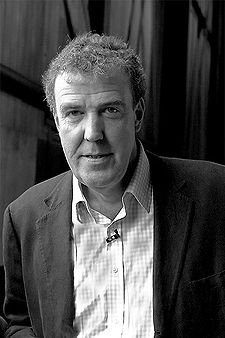
Jeremy Charles Robert Clarkson (born 11 April, 1960) is an English broadcaster and journalist who specializes in motoring. He is best known for his role on the BBC TV show Top Gear along with co-presenters Richard Hammond and James May. He also writes weekly columns for The Sunday Times and The Sun.
From a career as a local journalist in the North of England, Clarkson rose to public prominence as a presenter of the original format of Top Gear in 1988. Since the mid-1990s Clarkson has become a recognized public personality, regularly appearing on British television presenting his own shows and appearing as a guest on other shows. As well as motoring, Clarkson has produced program and books on subjects such as history and engineering. From 1998 to 2000 he also hosted his own chat show, Clarkson.
His opinionated but humorous tongue-in-cheek writing and presenting style has often generated much public reaction to his viewpoints. His actions both privately and as a Top Gear presenter have also sometimes resulted in criticism from the media, politicians, pressure groups and the public.
As well as the criticism leveled against him, Clarkson also generated a significant following in the public at large, being credited as a factor in the resurgence of Top Gear to the most popular show on BBC Two, and calls for him to be made Prime Minister. Clarkson himself was keen to downplay his perceived influence on the British public, stating he regularly contradicts himself, and would make a "rubbish" Prime Minister.
Personal Life
Born in Doncaster, then in the West Riding of Yorkshire, to teacher Shirley Gabrielle Ward and traveling salesman Edward Grenville "Eddie" Clarkson, his parents ran a business selling tea cosies. They put the young Jeremy Clarkson's name down in advance for a number of public schools with no idea how they were going to pay the fees, until at the last moment, when he was 13, they made two Paddington Bear stuffed toys for each of their children. These proved so popular that they started selling them through the business with sufficient success to be able to pay the fees for Clarkson to attend Hill House School, Doncaster and later Repton School.
By his own account, he was expelled from Repton School for "drinking, smoking and generally making a nuisance of himself."
Clarkson played the role of a public schoolboy, Atkinson, in a BBC radio Children's Hour serial adaptation of Anthony Buckeridge's Jennings novels until his voice broke.
For an episode of the first series of the BBC's Who Do You Think You Are? broadcast in November 2004, Clarkson was invited to investigate his family history. It included the story of his great-great-great grandfather John Kilner (1792–1857), who invented the Kilner jar: a container for preserved fruit.
Clarkson married his manager, Frances Cain (daughter of VC winner Robert Henry Cain) in May 1993 in Fulham. The couple currently live in the town of Chipping Norton, situated in the Cotswolds, with their three children (Emily, born August 1994; Finlo, born March 1996; and Katya, born November 1998). Known for buying him car-related gifts, for Christmas 2007 Clarkson's wife bought him a Mercedes-Benz 600.
In 2007, Clarkson and co-presenter James May were the first people to reach the magnetic North Pole in a car, chronicled in a Top Gear polar special.
Clarkson often compares his personality to that of a six-year old boy, which is the over-riding influence when it comes to reviewing cars or feats of engineering. Clarkson is 6 feet 5 inches (1.96 m), a fact that is often referred to in his car reviews.
Clarkson's fondness for wearing jeans has been blamed by some for the decline in sales of denim in the mid 1990s, particularly Levi's, due to being associated with middle aged men, the so-called 'Jeremy Clarkson effect'. After fashion gurus Trinny and Susannah labeled Clarkson's dress sense as that of a market trader, he was persuaded to appear on their fashion makeover show What Not to Wear in order to avoid being considered for their all time worst dressed winner award. Their attempts at restyling Clarkson were however all rebuffed, and
Clarkson stated he would rather eat his own hair than appear on the
show again.
As a self-confessed admirer of actress Kristin Scott Thomas Clarkson previously frequently mentioned her on Top Gear, with cars on the 'Cool Wall' being measured by whether they would impress Kristin if you arrived to pick her up in one. After a mock fall out on the show in 2007, Clarkson appointed Fiona Bruce as the 'new' muse of the Cool Wall.
According to a Sunday Mirror article from 12 October 2008, Clarkson sustained minor injuries to his legs, back and hand in a high-speed head-on collision with a brick wall during the filming of the 12th series of Top Gear.
Clarkson is in favor of personal freedom and very much against government regulation, stating that government should "build park benches and that is it. They should leave us alone." He has a particular contempt for the Health and Safety Executive. He has often criticized the Labor Governments of Tony Blair and Gordon Brown, especially the 'ban' culture, frequently fixating on the bans on smoking and 2004 ban on fox hunting. Clarkson is opposed to the opening up of the countryside to ramblers, under the right to roam, and became involved in a protracted legal dispute about access to a "permissive path" across the grounds of his second home on the Isle of Man since 2005.
Clarkson is often critical of political correctness. He often comments on the media-perceived social issues of the day such as the fear of challenging adolescent youths, known as 'hoodies'. In 2007 Clarkson was cleared of allegations of assaulting a hoodie while visiting Central Milton Keynes, after Thames Valley Police said that if anything, he had been the victim. Clarkson is a prominent Eurosceptic. In the six-part series Jeremy Clarkson Meets the Neighbors he traveled around Europe in a Jaguar E-type, examining (and in some cases reinforcing) his stereotypes of other countries.
As a motoring journalist, he is frequently critical of government initiatives such as the London congestion charge or proposals on road charging. He is also frequently scornful of caravaners and cyclists. He has often singled out John Prescott the former Transport Minister, and Stephen Joseph the head of the public transport pressure group Transport 2000.
Clarkson has long been noted for his pro-smoking viewpoint, with him even publicly smoking as much as possible on National No Smoking Day. He announced on 14 April, 2006 that he had given up smoking. He cited that he had found a cure for the urge — the Koenigsegg CCX. He also said: "(the cure) is called smoking", in reference to "smoking the tires". He later revealed that he had started smoking again.
On the environment, Clarkson is not sympathetic to the green agenda. He once said: "I do have a disregard for the environment. I think the world can look after itself and we should enjoy it as best as we can". He has little respect for groups such as Greenpeace, and believes that the "eco-mentalists" are a by-product of the "old trade unionists and CND lesbians" that hadn't gone away but merely found a new cause. Clarkson is not however a climate change denier, commenting on the effects of global warming - "let's just stop and think for a moment what the consequences might be. Switzerland loses its skiing resorts? The beach in Miami is washed away? North Carolina gets knocked over by a hurricane? Anything bothering you yet?"
In an attempt to prove the press and public furor over the 2007 UK child benefit data scandal was a fuss about nothing, he published his own bank account number and sort code, together with instructions on how to find out his address, in The Sun newspaper, expecting nobody to be able to remove money from his account. He later discovered that someone had been able to set up a monthly direct debit for £500 to Diabetes UK, and this person's identity was protected from the bank under the Data Protection Act 1998.
 Clarkson has been described as a "skillful propagandist for the motoring lobby" by The Economist and a "dazzling hero of political incorrectness" by Daily Mirror. With a forthright and sometimes deadpan delivery, Clarkson is said by
some to thrive on the notoriety his public comments bring, and has
risen to the level of the bête noire of the various groups who disagree with his views. On the Channel 4 organized viewer poll, for the 100 Worst Britons We Love to Hate program, Clarkson polled in 66th place just behind the writer and comic Ben Elton. By 2005, Clarkson was perceived by the press to have upset so many people and groups, The Independent put him on trial for various 'crimes', declaring him guilty on most counts. Criticism is often directed personally, with derogatory comments about residents of Norfolk leading to some residents organizing a "We hate Jeremy Clarkson" club. In The Guardian's
2007 'Media 100' list, which lists the top 100 most "powerful people in
the [media] industry", based on cultural, economic and political
influence in the UK, Clarkson was listed as a new entrant at 74th. Some
critics even attribute Clarkson's actions and views as being
influential enough to be responsible for the closure of Rover and the Luton manufacturing plant of Vauxhall. Clarkson's comments about Rover prompted workers to hang an "Anti-Clarkson Campaign" banner outside the defunct Longbridge plant in its last days.
Clarkson has been described as a "skillful propagandist for the motoring lobby" by The Economist and a "dazzling hero of political incorrectness" by Daily Mirror. With a forthright and sometimes deadpan delivery, Clarkson is said by
some to thrive on the notoriety his public comments bring, and has
risen to the level of the bête noire of the various groups who disagree with his views. On the Channel 4 organized viewer poll, for the 100 Worst Britons We Love to Hate program, Clarkson polled in 66th place just behind the writer and comic Ben Elton. By 2005, Clarkson was perceived by the press to have upset so many people and groups, The Independent put him on trial for various 'crimes', declaring him guilty on most counts. Criticism is often directed personally, with derogatory comments about residents of Norfolk leading to some residents organizing a "We hate Jeremy Clarkson" club. In The Guardian's
2007 'Media 100' list, which lists the top 100 most "powerful people in
the [media] industry", based on cultural, economic and political
influence in the UK, Clarkson was listed as a new entrant at 74th. Some
critics even attribute Clarkson's actions and views as being
influential enough to be responsible for the closure of Rover and the Luton manufacturing plant of Vauxhall. Clarkson's comments about Rover prompted workers to hang an "Anti-Clarkson Campaign" banner outside the defunct Longbridge plant in its last days.
However, the BBC often plays down his comments as ultimately not having the weight they are ascribed. In 2007 they described Clarkson as "Not a man given to considered opinion", and in response to an official complaint another BBC spokeswoman once said: "Jeremy's colorful comments are always entertaining, but they are his own comments and not those of the BBC. More often than not they are said with a twinkle in his eye." Some of his opponents state they take the view he is a man that should be ignored. Kevin Clinton, head of Road Safety at the Royal Society for the Prevention of Accidents (RoSPA) has stated "We don't take what he says too seriously and hopefully other people don't either."
On his chat show, Clarkson, he caused upset to the Welsh by placing a 3D plastic map of Wales into a microwave oven and switching it on. He later defended this by saying, "I put Wales in there because Scotland wouldn't fit."
His views on the environment once precipitated a small demonstration at the 2005 award ceremony for his honorary degree from Oxford Brookes University, when Clarkson was pied by road protestor Rebecca Lush. Clarkson took this incident in good humor, while Rebecca became known as "Banana girl" from the stunt. Clarkson has spoken in support of hydrogen cars as a solution.
In 2008 an internet petition was posted on the Prime Minister's Number 10 website to "Make Jeremy Clarkson Prime Minister". By the time it closed, it had attracted 49,446 signatures. An opposing petition posted on the same site set to "Never, Ever Make Jeremy Clarkson Prime Minister" attracted 87 signatures. Clarkson later commented he would be a rubbish Prime Minister as he is always contradicting himself in his columns. In their official response to the petition, it appears Number 10 agrees.
While his fashion sense and chauvinistic comments are often cited as making him unpopular with women, in a 2008 poll of 5,000 female members of an online dating website, Clarkson came third in a poll of MISAs – Men I Secretly Adore, behind Jonathan Ross and Phillip Schofield. Characteristically, Clarkson was upset not to have come top. Clarkson has often recognized and celebrated the fact that car fanatics can be found in both sexes.
In response to the reactions he gets, Clarkson has generally and consistently dismissed his importance, stating "I enjoy this back and forth, it makes the world go round but it is just opinion." and "I don't have any influence over what people do, I really don't. It makes no difference what I say. Top Gear is just fluff. It's just entertainment - people don't listen to me." On the opinion that his views are influential enough to topple car companies, he has argued that he has proof that he has had no influence. "When I said that the Ford Orion was the worst car ever it went on to become a best-selling car." His concerted attacks have similarly done no harm to the likes of the Toyota Corolla.
Career:
Writing
Clarkson's first job was as a traveling salesman for his parents' business selling Paddington Bear toys. He later trained as a journalist with the Rotherham Advertiser, before also writing for the Rochdale Observer, Wolverhampton Express and Star, Lincolnshire Life and the Associated Kent Newspapers.
In 1984 Clarkson formed the Motoring Press Agency (MPA), which, with a partner, he would conduct road tests for local newspapers and automotive magazines. This developed into pieces for publications such as Performance Car. He has regularly written for Top Gear Magazine since its launch in 1994.
Clarkson went on to writing articles for a diverse spectrum of readers through regular columns in both the mass-market tabloid The Sun, and for the more 'up market' broadsheet newspaper The Sunday Times. Both are owned by News International. newspaper
In addition to newsprint, Clarkson has written books about cars and several other humorous titles. Many of his books are aggregated collections of articles that he has written for the The Sunday Times.
Clarkson's first major television role came as one of the presenters on the British motoring program Top Gear, from 27 October 1988 to 3 February 2000, in the program's original format, and then again from 20 October 2002, when it was relaunched in a new format after a brief period off the air. He is credited with co-presenters James May and Richard Hammond as turning Top Gear BBC Two, rebroadcast to over 100 countries around the world. While closely associated with presenting motoring shows through the original Top Gear and Motorworld, by the late 1990s Clarkson had diversified into presenting programs on other topics, beginning as presenter of the UK version of Robot Wars. At the same time his television presence also branched out into appearances on a number of other shows, both as guest and guest host. From 1998 for three years he had his own chat show, Clarkson, hosting 27 half-hour episodes aired in the United Kingdom between November 1998 and December 2000, and featured guest interviews with musicians, politicians and television personalities. In his television career, Clarkson went on to present a number of documentaries focused on non-motoring themes such as history and engineering, although the motoring shows and videos continued. Alongside his stand-alone shows, many often mirror the format of his newspaper columns and books, combining his love of driving and motoring journalism, with the examination and expression of his other views on the world, such as in Jeremy Clarkson's Motorworld, Jeremy Clarkson's Car Years and Jeremy Clarkson Meets the Neighbors. into the most-watched TV show on
Clarkson's views are often showcased on television shows. In 1995 Clarkson appeared on the light hearted comedy show Room 101, in which a guest nominates things they hate in life to be consigned to nothingness. Clarkson dispatched caravans, flies, Last Of The Summer Wine, the mentality within golf clubs, and vegetarians. His public persona has seen him make several appearances on the prime time talk shows Parkinson and Friday Night with Jonathan Ross since 2002. By 2003 his persona was deemed to fit the mold for the series Grumpy Old Men, in which middle-aged men talk about any issues of modern life which irritate them. Since the topical news panel show Have I Got News for You dismissed regular host Angus Deayton in October 2002, Clarkson has become one of the most regularly used guest hosts on the show in a role which attracts a sideways look at current affairs. On a more serious platform, Clarkson has appeared as a panelist on the political current affairs television show Question Time twice since 2003.
In 2007 Clarkson won the National Television Awards' Special Recognition Award. Also in 2007, it was reported that Clarkson earned £1m a year for his role as a Top Gear presenter, and a further £1.7m from books, DVDs and newspaper columns.
Earlier in 2009 in Australia Clarkson called Gordon Brown 'a Scottish one eyed idiot', this was mis interpreted by many people as a direct attack at the PM. However Clarkson was only referring to Brown's ability to see who requires money in the UK and not his literal disability.
Clarkson has a keen interest in the British Armed Forces, with several Clarkson focused Top Gear spots having a military theme, be it Clarkson escaping a tank in a Range Rover, an Apache helicopter in a Lotus, a platoon of Irish Guardsmen in a Porsche and Mercedes or using a Ford Fiesta as a Royal Marine landing craft. Several of his DVDs and television shows have featured military hardware, and he has flown in military jets previously.
Clarkson presented a program looking at recipients of the Victoria Cross, in particular focusing on his father-in-law, Robert Henry Cain, who received a VC for actions during Operation Market Garden at Arnhem in World War II.
In 2007 Clarkson wrote and presented Jeremy Clarkson: Greatest Raid of All Time, a documentary about the World War II Operation Chariot, a 1942 Commando raid on the docks of Saint-Nazaire in occupied France.
At the end of 2007 Clarkson became a patron of Help for Heroes, a charity aiming to raise money to provide better facilities to wounded British servicemen. His effort led to the 2007 Christmas appeal in The Sunday Times supporting Help for Heroes.
Clarkson is passionate about engineering, especially pioneering work. In Inventions That Changed the World
Clarkson showcased the invention of the gun, computer, jet engine,
telephone and television. He has previously criticized the engineering
feats of the 20th century, as merely improvements on the truly
innovative inventions of the Industrial Revolution. He cites the lack of any source of alternative power for cars, other than by "small explosions". In Great Britons, as part of a public poll to find the greatest historical Briton, Clarkson was the chief supporter for Isambard Kingdom Brunel,
a prominent engineer during the Industrial Revolution credited with
numerous innovations. Despite this, he also has a  passion for many
modern examples of engineering. In Speed and Extreme Machines Clarkson rides and showcases numerous vehicles and machinery. Clarkson was awarded an honorary degree from Brunel University on 12 September 2003, partly because of his work in popularising engineering, and partly because of his advocacy of Brunel.
passion for many
modern examples of engineering. In Speed and Extreme Machines Clarkson rides and showcases numerous vehicles and machinery. Clarkson was awarded an honorary degree from Brunel University on 12 September 2003, partly because of his work in popularising engineering, and partly because of his advocacy of Brunel.
In his book, I Know You Got Soul he describes many machines that he believes possess a soul. He cited the Concorde crash as his inspiration, feeling a sadness for the demise of the machine as well as the passengers. Clarkson was a passenger on the last BAConcorde flight on 24 October 2003. Paraphrasing Neil Armstrong he described the retirement of the fleet as "This is one small step for a man, but one huge leap backwards for mankind", and that the challenge of building Concorde had been a greater human feat than landing a man on the Moon.
His known passion for single- or two-passenger high-velocity transport led to his brief acquisition of an English Electric Lightning F1A jet fighter XM172, which was installed in the front garden of his country home. The Lightning was subsequently removed on the orders of the local council, which "wouldn't believe my claim that it was a leaf blower", according to Clarkson on a Tiscali Motoring webchat. In fact, the whole affair was set up for his program Speed, and the Lightning is now back serving as gate guardian at Wycombe Air Park (formerly RAF Booker).
In a Top Gear episode, Clarkson drove the Bugatti Veyron in a race across Europe against a Cessna private aeroplane. The Veyron was an £850,000 technology demonstrator project built by Volkswagen to become the fastest production car, but a practical road car at the same time. In building such an ambitious machine, Clarkson described the project as "a triumph for lunacy over common sense, a triumph for man over nature and a triumph for Volkswagen over absolutely every other car maker in the world." After winning the race, Clarkson announced that "It's quite a hollow victory really, because I've got to go for the rest of my life knowing that I'll never own that car. I'll never experience that power again."
On April 25th 2009, filming the Top Gear Race to the North, from London Kings Cross Station to Edinburgh Balmoral Hotel between the new steam locomotive A1 class 60163 Tornado , a Jaguar XK120 and a Vincent Black Shadow motorbike, instead of choosing the car (driven by James May) he choose Tornado and rode on the footplate throughout even firing the locomotive at points.
